
Planning a new home or dealing with termites in an existing property? Discover the differences between pre-construction and post-construction anti-termite treatment, including application methods, costs, effectiveness and long-term protection.
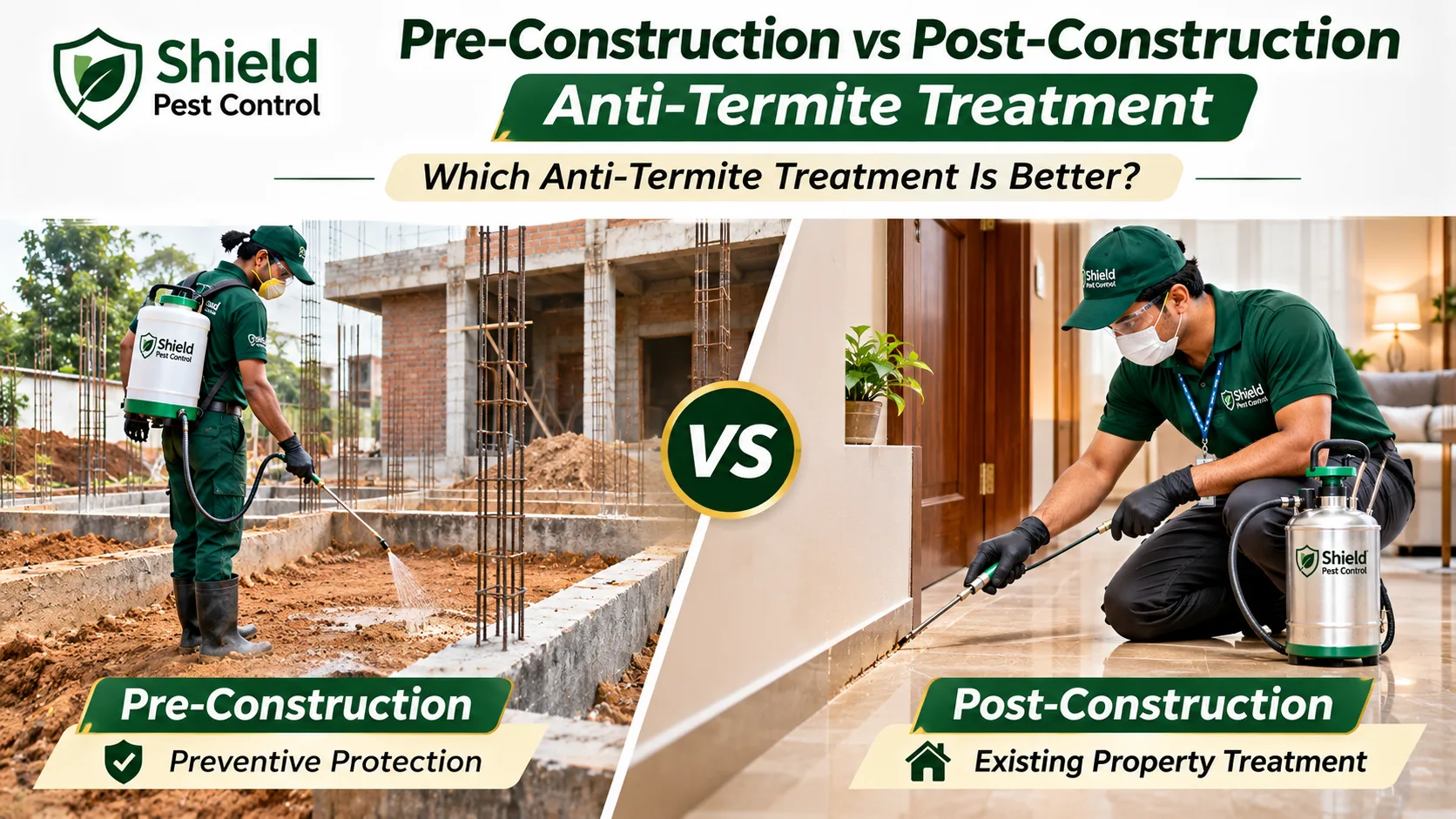
Pre-Construction vs Post-Construction Anti-Termite Treatment: What's Better?
Building a new house is exciting, but there's one important protection measure that often gets overlooked until the construction work is nearly complete: anti-termite treatment.
Termites can enter a property through soil, foundation gaps, plumbing openings and concealed structural joints. By the time you notice damaged wooden doors or hollow-sounding cabinets, the infestation may already be established.
This raises an important question for homeowners and builders: Is pre-construction anti-termite treatment better than post-construction treatment?
The answer depends on the stage of your property.
Pre-construction treatment is generally the better preventive opportunity for a new building because soil and foundation areas are accessible before construction is completed. Post-construction treatment is designed for existing buildings and can help manage active termite infestations or provide protection where earlier treatment was missed.
Both methods have an important role. Let's compare how they work, what they cost and which option makes sense for your property.
What Is Pre-Construction Anti-Termite Treatment?
Pre-construction anti-termite treatment is a preventive pest-control process carried out during the construction of a building.
The purpose is to create a treated zone in designated soil areas and reduce the likelihood of subterranean termites entering the structure from the ground.
Unlike treatment in an occupied house, pre-construction work provides access to areas that will later be covered by concrete, flooring or other building materials.
When Is Pre-Construction Termite Treatment Done?
The application is usually coordinated with the construction schedule. Depending on the building design and treatment specification, it may involve several stages:
Foundation preparation: Treatment of designated soil areas around foundation excavations before they become inaccessible.
Backfilled soil: Application to specified soil areas after foundation work and backfilling.
Plinth filling: Treatment of suitable soil surfaces before floor construction.
Wall-floor junctions: Attention to vulnerable interfaces and designated entry points.
External perimeter: Treatment of specified areas adjoining the building where required.
The actual sequence must follow the approved construction specification, product label and applicable technical standards.
For new houses, villas and commercial developments, professional pre-construction pest control services can be planned alongside foundation and flooring work.
Advantages of Pre-Construction Treatment
The biggest advantage is accessibility.
Technicians can reach soil areas that would be difficult or impossible to access once the building is finished.
Other benefits include:
Preventive protection can begin before occupancy.
Treatment can be coordinated with construction milestones.
Certain concealed areas can be treated without drilling through finished flooring.
The process may reduce the need for more disruptive treatment later.
It helps incorporate termite prevention into the building's maintenance planning.
However, the treatment must be properly applied and protected from disturbance during later construction work.
Pre-construction treatment does not make a building permanently termite-proof.
What Is Post-Construction Anti-Termite Treatment?
Post-construction anti-termite treatment is performed after a building has been constructed.
It is commonly recommended when termites are already present or when an existing property requires preventive protection.
Because the building is complete, the treatment approach is different.
Technicians must work around finished floors, walls, wooden fittings, plumbing and other structural elements.
How Does Post-Construction Termite Treatment Work?
The process begins with an inspection to identify termite activity, likely entry routes and affected areas.
Depending on the infestation and treatment method, the work may include:
Inspecting wooden doors, cupboards, skirting and wall-floor joints.
Identifying mud tubes and moisture-related conditions.
Creating suitable access points for soil treatment where necessary.
Applying an appropriately registered termiticide according to its label.
Treating affected wooden components where suitable.
Sealing treatment openings and providing preventive recommendations.
Not every post-construction treatment requires drilling. Some situations may be better suited to targeted treatment or monitored baiting systems.
For existing houses, apartments and offices, post-construction pest control services can help address termite activity after the building is occupied.
Advantages of Post-Construction Treatment
Post-construction treatment is valuable because it allows termite problems to be addressed even when no preventive work was carried out during construction.
Its benefits include:
Treatment of existing termite infestations.
Targeted attention to identified problem areas.
Options for homes, offices and commercial buildings.
Preventive treatment opportunities in existing structures.
Corrective treatment where earlier termite protection has been compromised.
The main challenge is access. Finished flooring, fixed cabinets and structural features may limit the areas that can be reached.
Pre-Construction vs Post-Construction Anti-Termite Treatment: Key Differences
ComparisonPre-ConstructionPost-ConstructionTreatment stageDuring constructionAfter constructionMain objectivePreventive protectionControl or prevention in an existing buildingSoil accessibilityGenerally betterOften restrictedDrilling through finished floorsUsually avoidable for initial soil treatmentMay be requiredDisruption to occupantsUsually none, as the building is unoccupiedRequires coordination and precautionsTreatment planningLinked to construction stagesBased on inspection and property conditionsCost considerationsOften more economical when planned earlyCan involve additional labour and access workBest suited forNew houses and buildings under constructionCompleted properties and active infestationsThe key difference: Pre-construction treatment focuses on protecting a building before it is completed, while post-construction treatment provides options for managing termite risks after construction.
Neither method guarantees that termites can never return.
Which Anti-Termite Treatment Is More Effective?
Both methods can be effective when properly selected and applied.
For a building that is still under construction, pre-construction treatment generally offers an important advantage because vulnerable soil areas are accessible.
A correctly planned treatment can establish protection at locations that would otherwise become concealed beneath finished construction.
For an existing building, however, post-construction treatment is often the practical choice.
The effectiveness of either method depends on factors such as:
Termite species and activity
Chemical formulation and approved application method
Soil conditions and moisture
Treatment coverage
Building design
Construction or renovation work after treatment
Ongoing inspection and maintenance
A poorly executed pre-construction treatment may provide less protection than a carefully planned post-construction programme.
The quality of treatment matters more than the label attached to the method.
Pre-Construction vs Post-Construction Termite Treatment Cost
Cost is an important consideration, particularly for homeowners comparing quotations during construction.
Pre-construction treatment may be more economical overall because the contractor can access soil areas before flooring and other finishes are installed.
Post-construction treatment may involve additional preparation, drilling, sealing and working around occupied spaces.
However, there is no universal price difference.
What Determines the Cost?
The final quotation depends on:
Property size and the actual treatment area.
Construction stage and accessibility.
Treatment method and chemical.
Soil and building conditions.
Severity of any existing infestation.
Labour and number of required applications.
Warranty and follow-up conditions.
For example, a 2,000-square-foot new house requiring preventive treatment may have a different scope from a completed 2,000-square-foot house with termites affecting several rooms.
Even though both properties have the same floor area, their treatment requirements may be very different.
When comparing quotations, ask whether the rate is calculated using built-up area, treated floor area, foundation dimensions or another measurement.
You should also confirm whether the quotation includes all required treatment stages, chemicals, labour and applicable taxes.
Is Pre-Construction Termite Treatment Necessary for a New Home?
If you're building a new home, considering termite protection during construction is a sensible preventive measure, especially where subterranean termites are a concern.
Once the foundation and flooring are completed, many areas become inaccessible without additional work.
Pre-construction treatment provides an opportunity to address those areas before they're covered.
However, the need for treatment and the appropriate method should be assessed according to the property, site conditions and applicable building requirements.
For builders and homeowners, planning the work early can also reduce scheduling problems.
Rather than arranging termite treatment at the last moment, coordinate it with your construction contractor and pest-control provider.
What If Your Builder Did Not Provide Anti-Termite Treatment?
Discovering that your house was built without pre-construction termite treatment does not mean termites will definitely infest it.
It simply means that a particular preventive measure may not have been installed.
If the building is already complete, a professional inspection can help determine whether preventive post-construction treatment is appropriate.
The technician should assess the building's construction, soil access, moisture conditions and signs of termite activity.
If termites are already present, treatment should focus on the actual infestation rather than relying only on general preventive spraying.
Can You Do Both Pre-Construction and Post-Construction Treatment?
Yes, but that does not mean every property needs both treatments automatically.
A building may receive pre-construction protection and later require corrective or supplementary treatment if:
Termite activity is discovered.
Renovation disturbs treated soil.
Plumbing or excavation work compromises a treatment zone.
New structural additions create untreated entry points.
An inspection identifies areas needing further attention.
The appropriate action depends on the original treatment record, current property conditions and inspection findings.
Unnecessary chemical applications should be avoided.
Anti-Termite Treatment for Apartments in Greater Noida West
Apartment buildings require a different approach from independent houses because foundations, common areas and utility systems may be shared.
For a new apartment project, preventive termite treatment is generally coordinated at the construction-project level.
For an occupied flat, post-construction treatment may focus on affected wooden fittings, accessible entry points and relevant structural areas.
Termite activity in one apartment can sometimes require coordination with building management, especially where shared infrastructure is involved.
Shield Pest Control serves residential properties in Greater Noida West, Noida and nearby areas.
A suitable treatment recommendation should account for the apartment's location, construction and visible termite activity.
Anti-Termite Treatment in Noida and Ghaziabad
Homes and commercial buildings across Noida, Indirapuram, Vaishali, Vasundhara and other parts of Ghaziabad may face different termite risks depending on construction and moisture conditions.
A newly constructed independent house may benefit from preventive soil treatment during construction.
An older property with damaged wooden door frames may require inspection and targeted post-construction treatment.
Commercial premises with extensive wooden partitions, storage materials or fixed furniture may need a more detailed treatment plan.
Shield Pest Control provides termite control services for residential and commercial properties.
Our approach is to understand the property and the pest problem before recommending treatment.
What Should You Check Before Hiring an Anti-Termite Treatment Company?
A professional quotation should explain more than the treatment price.
Before approving the work, ask these questions:
Which areas will be treated? The scope should clearly identify covered and excluded areas.
What chemical will be used? Request the product name and information about the application method.
How many visits are required? Pre-construction treatment may involve multiple construction stages, while post-construction treatment schedules vary.
Will drilling be necessary? Ask where treatment access points are proposed and how they will be finished.
What safety precautions are required? Follow product-specific preparation, ventilation and re-entry instructions.
Is a written warranty included? Confirm its duration, coverage and conditions.
Will a service report be provided? Treatment records can be useful for future inspections and property maintenance.
A transparent quotation makes it easier to compare providers and understand what you're purchasing.
Frequently Asked Questions
Is pre-construction termite treatment better than post-construction treatment?
For a new building, pre-construction treatment is generally preferable as a preventive measure because soil and foundation areas are accessible. For a completed property, post-construction treatment is the practical option.
How long does pre-construction termite treatment last?
Its effective life varies according to the chemical, application, soil conditions and disturbance of treated areas. It should not be considered permanent protection.
Can termites enter a house after pre-construction treatment?
Yes. Termites may enter through untreated areas, disturbed treatment zones or new entry points. Regular inspections remain important.
Is drilling compulsory for post-construction termite treatment?
No. Drilling may be necessary for certain soil-treatment methods, but other treatment approaches may be suitable depending on the infestation and property.
Which termite treatment is cheaper?
Pre-construction treatment is often more economical to implement when planned during building work, but the final cost depends on the treatment specification, property size and site conditions.
Can termite treatment be done in an occupied house?
Yes, many post-construction treatments can be performed in occupied properties with appropriate planning. Occupants must follow the required safety and re-entry instructions.
Does anti-termite treatment protect wooden furniture?
Some termite treatments help protect a building against subterranean termite entry, while affected wooden furniture may require separate assessment and treatment.
Should I get termite treatment before laying floor tiles?
For a new building, designated soil treatment is typically planned before the relevant surfaces become inaccessible. The exact stage should follow the approved construction and treatment specification.
Final Verdict: Which Termite Treatment Should You Choose?
If you're constructing a new home, pre-construction anti-termite treatment is generally the better preventive opportunity because it allows access to vulnerable soil and foundation areas before construction is complete.
If your home or office is already built, post-construction anti-termite treatment is the appropriate route for investigating and managing termite activity.
Both methods can provide valuable protection when the treatment is properly designed, applied and maintained.
The best decision is based on your property's condition, not simply the lowest quoted price.
Get Professional Anti-Termite Treatment from Shield Pest Control
Whether you're planning a new house or dealing with termites in an existing property, Shield Pest Control can help you explore suitable treatment options.
We provide termite-control solutions for independent houses, apartments, offices and commercial properties in Noida, Greater Noida West, Ghaziabad and surrounding service areas.
Contact Shield Pest Control
Call / WhatsApp: +91 8595223441
Email: ankur@pestscontrolservices.in
Website: https://www.pestscontrolservices.in/
Request a termite treatment quotation and get guidance suited to your property's construction stage.